
Tutorials
Escaping SketchUp Fatigue: Why Architects are Automating DXF to 3D in Seconds
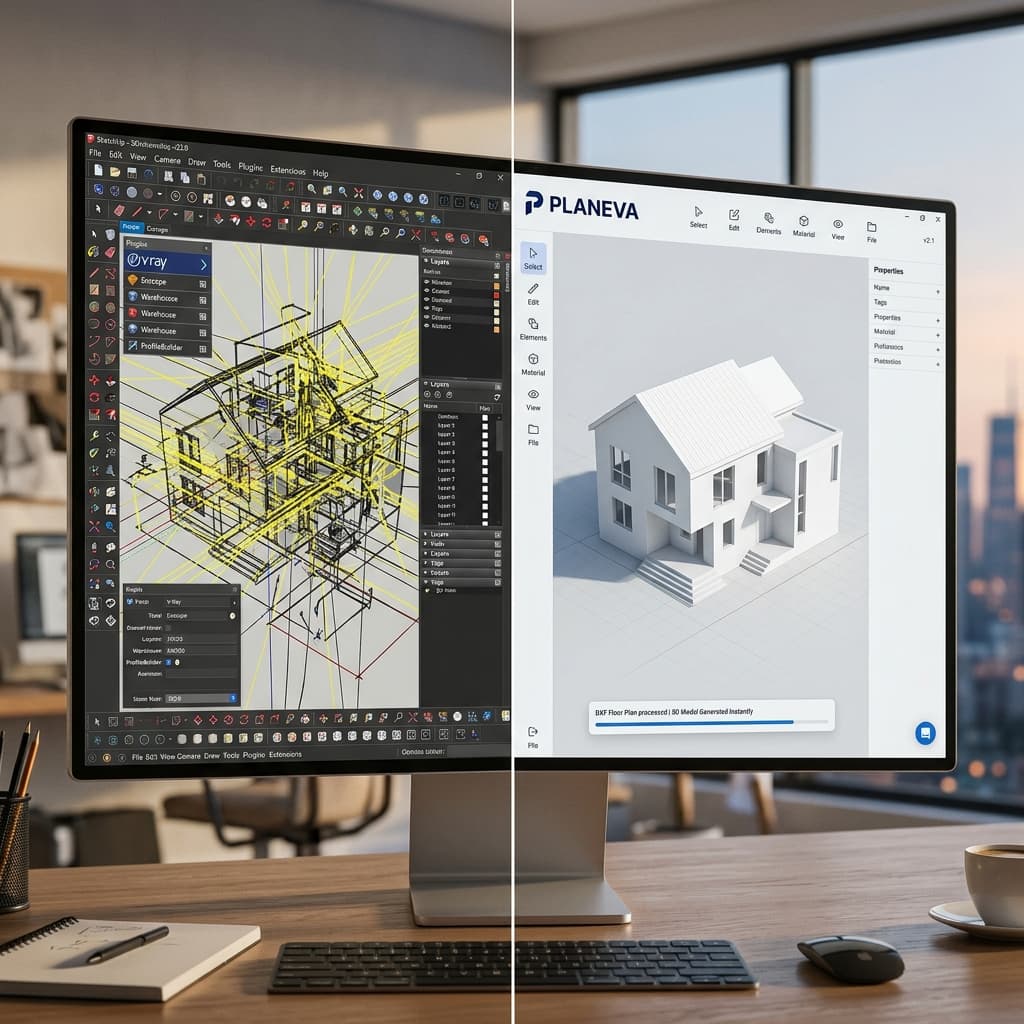
If your day is disappearing into Make Face fixes and repetitive wall lifting, it’s time to upgrade: convert DXF plans into review-ready 3D in seconds with Planeva—faster, cleaner, and more consistent.
The manual modeling trap
There’s a specific kind of burnout architects don’t talk about enough: SketchUp fatigue.
Not the “design is hard” part—the manual labor part. The part where your hours vanish into:
- Fighting linework until Make Face finally decides to cooperate
- Stitching tiny gaps and broken edges that should never matter in a review model
- Raising walls one by one, re-checking heights, re-fixing corners, re-fixing openings
That isn’t modeling. It’s construction site work—inside a modeling tool.
And worse: it’s fragile. One late plan revision and your “progress” turns into rework. The team becomes reluctant to iterate because iteration means rebuilding the same objects again.
From DXF to Review-Ready in 60 seconds
Planeva is built for a different premise: most early-stage architectural 3D doesn’t need hand-crafted mesh artistry—it needs clean, consistent, review-ready geometry generated from reliable plan signal.
When you bring a DXF floor plan into Planeva, the workflow is designed to remove the repetitive steps:
- Detect and build walls automatically from plan linework
- Place openings (like windows/doors) with consistent rules
- Produce a 3D output that’s fast to review, iterate, and export
Instead of spending your best hours “lifting walls,” you spend them on what clients actually pay for: decisions.
Planeva vs. Manual Modeling Checklist
- Planeva: start from clean DXF signal; Manual: start from fragmented linework and hope it closes
- Planeva: walls generated by rules; Manual: walls rebuilt repeatedly per revision
- Planeva: openings placed consistently; Manual: openings drift between team members and versions
- Planeva: review-ready output in minutes; Manual: “almost ready” stretches into hours
- Planeva: iteration encourages better options; Manual: iteration gets rationed because it’s too costly